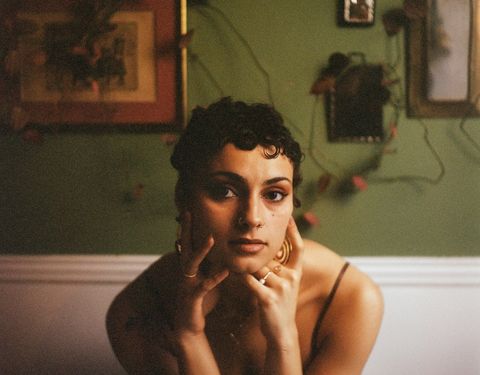
Somaya was going through it during the COVID-19 pandemic. (Who among us wasn’t?) The Gatineau-born singer and songwriter had decided to move to Montréal in 2021 to pursue a creative life. A piano player from the age of six, and singing since she practically started speaking as a child, she wouldn’t become a songwriter until her pre-teen years. But the move, and perhaps the isolation of the pandemic, helped Somaya forge a musical path that led her to release the dreamy debut, LAYALI, in late August this year.
An ethereal sonic landscape, LAYALI weaves R&B with Middle Eastern textures. The experimental and considered production fit perfectly next to Somaya’s soulful, nearly mystical, and totally cinematic lyrics that evocatively explore themes of loneliness, heartache, and family.
Somaya doesn’t want to give any big takeaways from the record. Instead, the project specifically stands for how being vulnerable with herself becomes a fearless act strengthening her own power, and that creates a space for listeners to feel and do something similar.
“I gravitate to a lot of artists like Little Simz and Doechii because it’s music that has something to say and I relate to it. I’m repeating every word in their songs like, ‘Yes, you said that so well, girl.’ I don’t want to be afraid to create that feeling for others.”
“I trust in people’s desire to feel, and I trust in my own ability to be the gateway sometimes.”
Somaya is inspired by artists who are experimental and intricate in their work such as Frank Ocean and Saya Grey. Those who don’t conform to rigid sonic structures. “As I started learning about different sounds and production, I was also listening to music differently, which helped me write the album.”
Somaya’s not afraid to admit that, in the beginning of her musical journey, she was not an expert at everything. “I have no idea what the hell I’m doing,” she explains, “I kind of let it come to me through a trial-and-error process. My main instrument is my voice, so a lot of the time I create demos, start playing with different sounds, instruments, and see what fits together. I work with a lot of talented musicians and producers, which helps because you get to create this magical world together.
“It’s just like a flow. I reach a flow state and then I create.”
LAYALI is produced by Somaya and em & i, a close friend and producer who worked on most of the tracks. Additionally, she enlisted the help of friends to add percussion, guitar, bass, and oud (a lute-like string instrument.) The arrangements at the end of the record were composed by Arturo Marzoratti. Throughout, she still keeps it modern, current, and even a little forward-thinking, blending reggae and slow burning R&B on “RHINESTONES” and a soft, stripped back ballad such as “MARY,” which is a tender track about escaping loneliness by smoking a lot of weed.
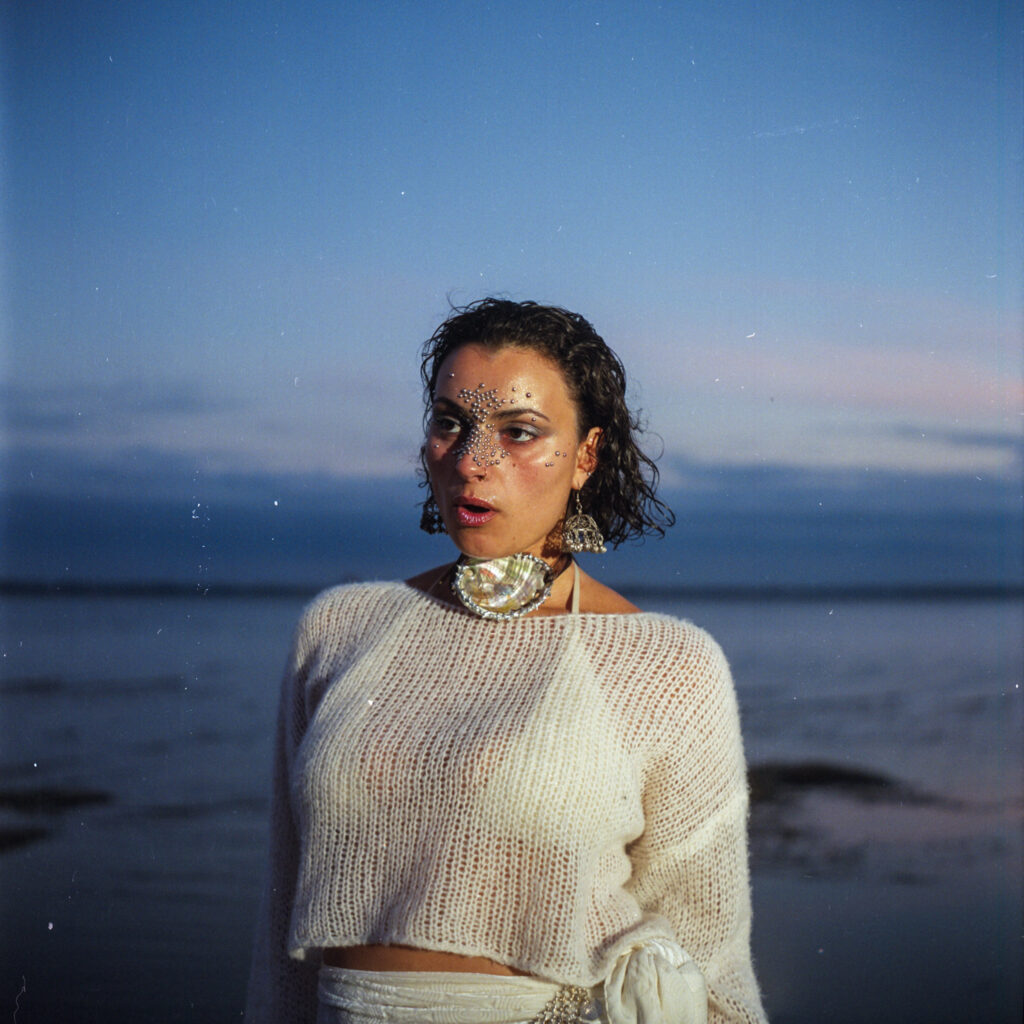
Somaya. Photo by Pavel Navarro.
But these Arabic touches are important to the Egyptian artist, and to our understanding of the work as a whole. In particular, she was inspired by a distinguished Egyptian performer. “A lot of these songs were created by us talking through ideas, arrangements, and inspirations, and I was very inspired by Umm Kulthum. A lot of her songs are stretched out, with really long intros, which is something you see in the entirety of my album. All these songs have their own kind of moment.”
This album became a vehicle for Somaya to foster a deeper connection with her family and cultural identity. “I don’t speak Arabic. I didn’t grow up speaking my mom’s language. When I go back to Egypt, I almost feel like I can understand, but I can’t, which has been frustrating my whole life,” she explains.
“Including sonic elements of my culture into my debut album was a way for me to communicate in a way that words couldn’t. The record was an opportunity to connect with my family in a way that I haven’t been able to for a while. My grandparents passed when I was in high school and I feel like there’s a lot of things that I would have loved to know and experience with them.”
There’s an immediate appreciation of family, particularly the women, and how connected she is to her Northern African cultural roots, even and especially at home in Québec at the dinner table.
“In the intro to ‘PEARLS AND PLUMS,’ you can hear my sister ranting about this Egyptian dish she really hates,” Somaya says. “She was going back and forth about this with my mom, talking about hating the slimy texture of the food. I think it was the perfect way to get a bit of my sister in there.”
On “EL HENNA,” the earthy sound of the oud is accompanied by lush harmonies sung by both Somaya and her mother. This track comes from an old Egyptian wedding song her mother sang to her as a lullaby when she was younger.
“I layered the harmonies and worked on the track while she sat next to me. We were both very emotional, but I think it was a very nice bonding moment,” she says. “It’s one of my favourite songs on the record to listen to.”